
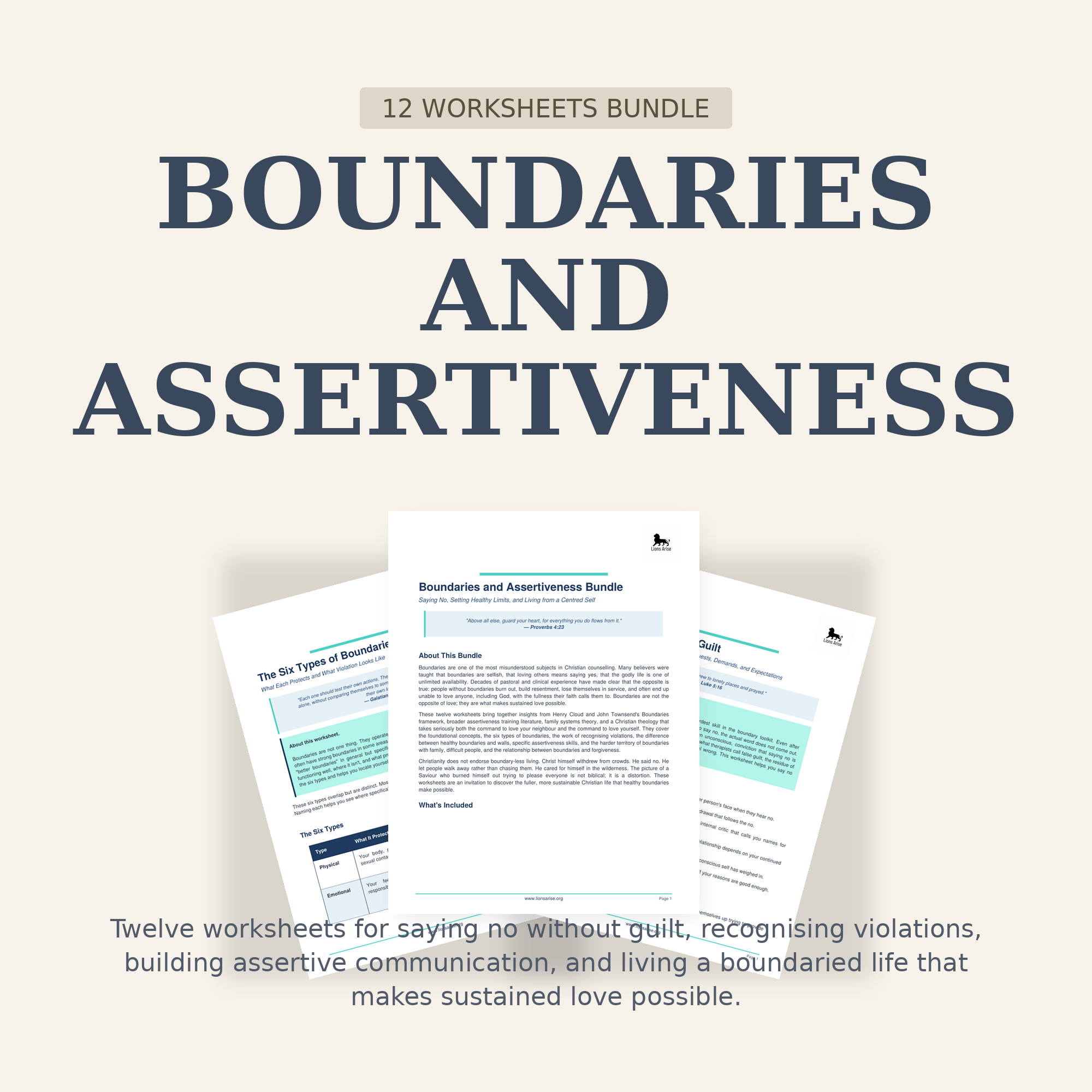
About This Bundle
Boundaries are one of the most misunderstood subjects in Christian counselling. Many believers were taught that boundaries are selfish, that loving others means saying yes, that the godly life is one of unlimited availability. Decades of pastoral and clinical experience have made clear that the opposite is true: people without boundaries burn out, build resentment, lose themselves in service, and often end up unable to love anyone, including God, with the fullness their faith calls them to. Boundaries are not the
opposite of love; they are what makes sustained love possible.
These twelve worksheets bring together insights from Henry Cloud and John Townsend's Boundaries framework, broader assertiveness training literature, family systems theory, and a Christian theology that takes seriously both the command to love your neighbour and the command to love yourself. They cover the foundational concepts, the six types of boundaries, the work of recognising violations, the difference
between healthy boundaries and walls, specific assertiveness skills, and the harder territory of boundaries with family, difficult people, and the relationship between boundaries and forgiveness. Christianity does not endorse boundary-less living. Christ Himself withdrew from crowds. He said no. He let people walk away rather than chasing them. He cared for himself in the wilderness. The picture of a Saviour who burned Himself out trying to please everyone is not biblical; it is a distortion. These worksheets are an invitation to discover the fuller, more sustainable Christian life that healthy boundaries make possible.
What's Included:
Bundle description: Twelve worksheets for one of the most misunderstood subjects in Christian counselling. Many believers were taught that boundaries are selfish, that loving others means saying yes, that the godly life is one of unlimited availability. Decades of pastoral and clinical experience have made clear that the opposite is true: people without boundaries burn out, build resentment, lose themselves in service, and often end up unable to love anyone, including God, with the fullness their faith calls them to. Boundaries are not the opposite of love; they are what makes sustained love possible. This bundle integrates Henry Cloud and John Townsend's framework, broader assertiveness training literature, family systems theory, and a Christian theology that takes seriously both the command to love your neighbour and the command to love yourself.
01 Introduction to Boundaries — What boundaries are and are not. Why they are essential rather than selfish. Christ as a model of healthy boundaries with specific gospel examples.
02 Why Boundaries Are Hard for Christians — The specific obstacles in Christian formation: misread scriptures (turn the other cheek, die to self, submit, bear one another's burdens), false guilt, ministry expectations, and family loyalty culture.
03 The Six Types of Boundaries — Physical, emotional, mental, time, material, and spiritual. What each protects, what violation looks like, and a self-rating exercise across all six.
04 Recognising Boundary Violations — The body signals, emotional signals, and behavioural signals that tell you a violation is happening. Building real-time recognition rather than after-the-fact analysis.
05 Identifying Your Boundary Patterns — Porous, rigid, or healthy across different relationships and domains. A 10-relationship mapping exercise to see your specific patterns rather than treating boundaries in general.
06 The Wall vs the Healthy Boundary — Why walls and boundaries are different. Where walls come from (repeated violation, spiritual abuse, family patterns), how to recognise yours, and the work of moving from wall to healthy boundary.
07 Assertive Communication Skills — The three communication styles (passive, aggressive, assertive). Core skills: I-statements, broken record, fogging, the three-sentence rule, and pause before responding.
08 Saying No Without Guilt — What stops people from saying no, what you don't owe (reasons, alternatives, apologies, long explanations), eight phrases for saying no, and how to tell false guilt from real guilt.
09 Boundaries with Difficult People — Realistic strategies for those who don't respect boundaries. Common difficult patterns (manipulation, aggression, guilt-tripping, triangulation, stonewalling, DARVO) and what you cannot do, said honestly.
10 Boundaries in Family Systems — The hardest territory. Honouring parents without obeying them as adults, common family challenges, practical principles for family-of-origin and family of choice, including united-front work for couples.
11 Boundaries and Forgiveness — The misunderstood relationship. Forgiveness vs reconciliation explained in detail, what each requires, and freedom from the false equation that boundaries equal unforgiveness.
12 Living a Boundaried Life — Capstone integration. Eight markers of boundaried life with self-rating, what it looks like across daily rhythm, relationships, work, ministry, family, and faith. Closes with a blessing and Galatians 5:1.