
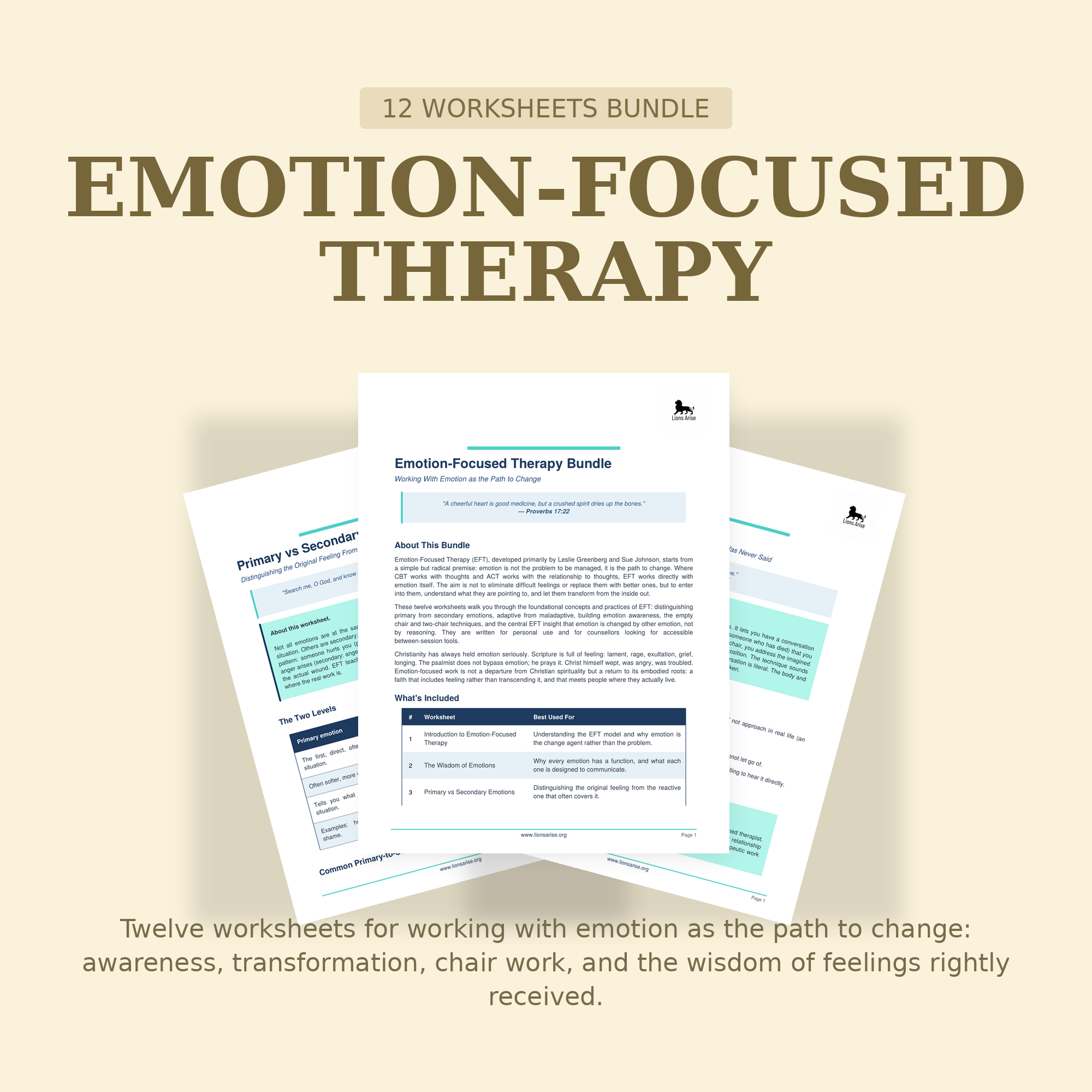
About This Bundle
Emotion-Focused Therapy (EFT), developed primarily by Leslie Greenberg and Sue Johnson, starts from a simple but radical premise: emotion is not the problem to be managed, it is the path to change. Where CBT works with thoughts and ACT works with the relationship to thoughts, EFT works directly with emotion itself. The aim is not to eliminate difficult feelings or replace them with better ones, but to enter into them, understand what they are pointing to, and let them transform from the inside out.
These twelve worksheets walk you through the foundational concepts and practices of EFT: distinguishing primary from secondary emotions, adaptive from maladaptive, building emotion awareness, the empty chair and two-chair techniques, and the central EFT insight that emotion is changed by other emotion, not by reasoning. They are written for personal use and for counsellors looking for accessible between-session tools.
Christianity has always held emotion seriously. Scripture is full of feeling: lament, rage, exultation, grief, longing. The psalmist does not bypass emotion; he prays it. Christ himself wept, was angry, was troubled. Emotion-focused work is not a departure from Christian spirituality but a return to its embodied roots: a faith that includes feeling rather than transcending it, and that meets people where they actually live.
What's Included:
Bundle description: Twelve worksheets walking you through the foundational concepts and practices of Emotion-Focused Therapy (EFT). Developed primarily by Leslie Greenberg, EFT starts from a radical premise: emotion is not the problem to be managed, it is the path to change. These worksheets work directly with emotion itself — distinguishing the kinds, building awareness, doing chair work, and applying the central EFT insight that emotion is changed by other emotion. Integrated with Christian theology of feeling, this bundle is for anyone whose inner work needs to go beyond cognitive insight and into the heart itself.
01 Introduction to Emotion-Focused Therapy — The three approaches to emotion (manage, reframe, enter) and why EFT chooses the third. Six core principles of EFT, with prompts for locating yourself within the framework.
02 The Wisdom of Emotions — Why every emotion has a function. A nine-emotion chart of what each is designed to do, what it asks of you, and what happens when overridden.
03 Primary vs Secondary Emotions — Distinguishing the original feeling from the reactive one that often covers it. Includes common patterns (hurt under anger, grief under anxiety) and a structured walk-through for finding the primary in a real situation.
04 Adaptive vs Maladaptive Emotions — Telling apart the emotions that fit the present from old, stuck patterns triggered by what resembles the past. Three diagnostic tests and different responses for each kind.
05 Emotion Awareness — The foundational skill of noticing, naming, and tolerating emotion. Includes a richer emotion vocabulary across eight families and a week-long awareness log.
06 Emotion Regulation Skills — Bidirectional tools: turning down emotion that is flooding and turning up emotion that has been suppressed. Six skills for each direction with a personal regulation plan.
07 The Empty Chair — Dialoguing with another person to express what was never said. Step-by-step setup, preparation prompts, and aftercare guidance for one of EFT's most powerful techniques.
08 The Two-Chair Technique — Working with internal conflict by giving each side a chair and a voice. Includes common splits, structured method, and a wise-self closing position.
09 Unfinished Business — Grief, anger, and hurt held over from past relationships. An honest inventory of unfinished pieces and a deep walk-through for working one through to release.
10 Self-Compassion Practice — Meeting your own difficult emotions with the kindness you would offer a friend. Kristin Neff's three components and the self-compassion break.
11 Emotion Transformation — The central EFT insight: emotion is changed by other emotion, not by reasoning. A chart of common transformations (compassion meeting shame, anger meeting fear) and how to access the transforming emotion.
12 Living an Emotionally Whole Life — The capstone. Markers of emotional wholeness with a self-rating exercise, what the work looks like across daily life, relationships, conflict, faith, and body, plus a closing blessing.